
Couldn't load pickup availability
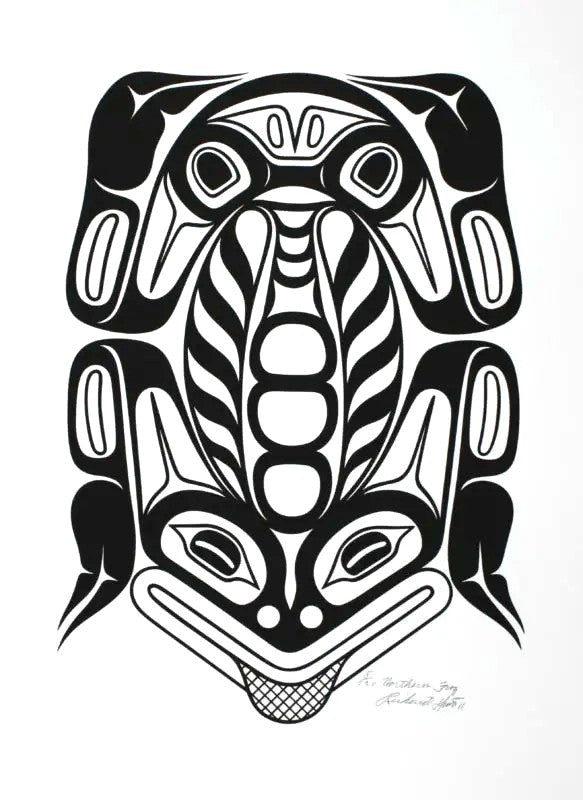
Northern Frog
Northern Frog
Product Type: Artwork
Richard Hunt drew this study of a northern frog over 25 years ago. The design is a traditional Tlingit design and Richard is a descendant of the Tongas Tlingit from Alaska through his great-great grandmother, Mary Ebbitts.
The frog is a key symbol in Northwest Coast Native art and culture. Indigenous peoples of the region believe it lives in both the human and spirit worlds, valued for its adaptability and its unique ability to connect the two realms.
Frog is recognized as a healer in many Native customs all over North and South America. Many old European traditions also recognize Frog’s ability to heal. Its songs are believed to be magical and contain divine power. They are cleansers of bad spirits.
The frog symbolizes wealth, abundance, ancient wisdom, rebirth, and good luck. In Northwest Coast art, a frog’s tongue touching another creature signifies the sharing of knowledge and power. When depicted alone, the frog often has a wide mouth and protruding tongue (see also Wak’es, Tree Frog, and Sharing Knowledge). On totem poles, the frog is placed at the bottom with its legs stretched out to represent stability.
This limited edition silkscreen print titled “Northern Frog” by Richard Hunt was hand produced by the screen-printing process. The artist has inspected and signed each copy in the edition. All trial copies of this edition have been destroyed and the printing stencils obliterated.
Published by Cedar Hill Long House Native Art Prints
Richard Hunt is one of Canada’s most celebrated Northwest Coast artists. He was born in 1951 in Alert Bay, British Columbia, and comes from a long line of respected Kwakwaka’wakw artists and carvers. His family’s legacy helped keep Kwakwaka’wakw art alive, and it shaped his own path from an early age.
He began carving with his father, the late Henry Hunt, when he was 13. A year later, Richard started an apprenticeship with Henry at the Royal BC Museum in Victoria. In 1974, he became chief carver for the Thunderbird Park carving program—a role once held by his grandfather, Mungo Martin. Over the next 12 years, he carved in public view, demonstrated traditional techniques, and shared his culture with visitors.
In 1986, Richard embarked on his journey as a freelance Indigenous artist, drawing even greater attention to his work. Soon after, he earned prestigious honours: the Order of British Columbia in 1991 and the Order of Canada in 1994.
His career has taken him across the globe. He crafted a 30‑foot totem pole for a private collector in Los Angeles and delivered lectures at the Smithsonian Institution. In Victoria, he designed the bronze medal for the 1994 Commonwealth Games and contributed to carving the Queen’s Baton alongside artists Art Thompson and Charles Elliott, uniting three Vancouver Island First Nations in a powerful cultural statement.
In 2012, the Royal Canadian Mint showcased his Kwaguilth design Two Loons on a silver coin commemorating the 25th anniversary of the loonie, having previously featured one of his welcome figure designs in 2005.
His Kwakwaka’wakw name, Gwe‑la‑yo‑gwe‑la‑gya‑lis, translates to “a man that travels and wherever he goes, he potlatches.” Through his art, speaking, and dancing, he continues to share his culture with the world.
Edition Size: 120 signed and numbered, plus 12 artist's proofs, 12 remarques, and 2 printer's proofs
Paper Size: 53 x 38 cm (21 x 15 inches)
Image Size: 39 x 28 cm (15.5 x 11 inches)
Publication Year: 2011
SKU:RH-NFR
Share